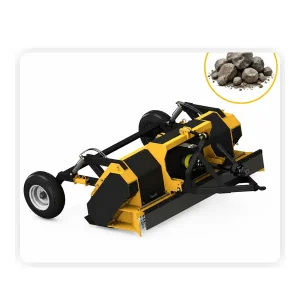
Stone Crushers
Evidence-backed overview, product subfamilies, selection variables and RFQ preparation.
Stone Crushers selectionStone Crushers: choose the family, then prove the interfacesStone-crusher and rocky-soil equipment selection starts with the material and the prime mover. Feed or ground condition, stone size/hardness, required working width/depth, tractor or drive power/PTO data, target throughput or finish, site mobility, dust and shock conditions and service access should be recorded before a machine or drivetrain is confirmed. The selected current HZPT source establishes the PSW-3200 family identity but not a universal performance claim for every site.Stone / soil or feed descriptionMaximum and typical size / hardness contextWorking width/depth or feed opening targetTractor / motor and PTO / input speedShock, dust, alignment and mobility conditionsTarget output, finish and maintenance accessCommon product familiesFrequently requested stone crushers familiesThese are routing families for the enquiry. They help a buyer reach the right technical checklist without pretending that one family description defines every model.PSW-3200Current-domain model family reference; final application match requires tractor/drive and material-condition confirmation.PSW-3200AFamily variant shown by the current HZPT source; variant-specific release data should be tied to the quotation.PSW-3200BFamily variant shown by the current HZPT source; do not infer performance solely from the shared family name.Drivetrain reviewPTO/cardan, gearbox and connected rotating elements reviewed for shock, angle, speed, torque and guarding.Ground / feed-condition reviewRock, soil, moisture, contamination and target result recorded so the machine duty is described rather than assumed.Application & compatibilityDescribe the duty that changes the answerRocky agricultural ground, site preparation and aggregate/stone duties can impose very different loads even when equipment appears similar. Include representative material photographs with a scale, known hard inclusions, moisture, desired working result and the prime-mover data. For repeated driveline failures, record the failure location and operating event; a stronger shaft is not necessarily the right correction if overload originates in the machine or material condition.For a technically complete enquiry, identify which of these families is closest—PSW-3200, PSW-3200A, PSW-3200B, Drivetrain review, or Ground / feed-condition review—and then describe the actual operating conditions. The family name is only a routing decision. The released product still depends on the drawing, mating components and duty. If a current part is being replaced, record the designation exactly as marked and add measured data that can detect an incorrect or superseded identification.Procurement should separate confirmed, derived and unknown values. Confirmed dimensions come from the controlling drawing or direct measurement; derived values should show the calculation basis; unknown values should be listed as questions for HZPT engineering. That discipline makes supplier responses comparable and prevents a nominal catalogue value from becoming an accidental purchase requirement.Evidence boundaryWhat this category can state—and what still belongs in the RFQThe current HZPT page establishes the PSW-3200 / A / B identity. Because the source terminology overlaps stone-crusher and rotavator functions, the category stays RFQ-led and avoids inventing universal capacity, power or performance values.A category page is therefore an engineering map, not a substitute for a released product drawing. Numerical values shown on a product page or technical table should be read within that exact series and configuration. When a value controls fit, safety, performance or acceptance, repeat it in the enquiry and ask the quotation to reference the same revision.RFQ checklistSelection variables to put on the enquiryUse one marked-up drawing or worksheet so each variable has a value, unit and source. If the machine has several operating modes, identify the normal case and the credible peak or upset case separately.1. Stone / soil or feed description2. Maximum and typical size / hardness context3. Working width/depth or feed opening target4. Tractor / motor and PTO / input speed5. Shock, dust, alignment and mobility conditions6. Target output, finish and maintenance accessReplacement tip: include photos of both mating interfaces, but do not use a photograph scale as the only dimensional evidence. Hidden shoulders, splines, port threads, bolt circles and working movement often determine interchangeability.Receiving & releaseMake the final order measurableBefore production or shipment, confirm which document controls the configuration and which items the buyer will inspect. A strong purchase description names the drawing revision, material/finish only where it matters, critical interface dimensions, functional duty and any inspection or reporting requirement. Avoid copying unrelated certificates or performance claims into the order; ask for evidence tied to the actual feature you need.Drawing revisionUse one released drawing or configuration sheet as the baseline.InterfacesList the dimensions and connection features that determine fit.DutyRecord the normal range and credible peaks or transients.AcceptanceState the dimensions, functional checks or documents needed at receipt.Additional engineering / inspection view for this product family.Supplier reviewAsk the quotation to state what is selected and what remains openA useful supplier response should identify the proposed family or model, summarize the duty and interfaces used for selection, and list every value that still needs confirmation. It should also identify the drawing or data sheet that will control production. That makes technical comparison easier when two quotations use different catalogue naming or when a replacement part has evolved from the original designation.Before approval, check that the offer has not silently substituted a nominal or “typical” value for a dimension, duty or material requirement that your application actually controls. If a deviation is acceptable, record it deliberately in the released document instead of relying on a conversation that will not be visible at receiving inspection.FAQStone Crushers enquiry questionsCan HZPT quote from a photo or old model number only?Those references help identify the family, but a reliable replacement review also needs measurable interfaces and the machine or process duty.Why are some values left as “confirm”?Because the selected evidence does not support one universal value for every configuration. Leaving the item open is more accurate than inventing a number.What should be approved before release?Approve the controlling drawing or configuration, interfaces, application duty, required material/finish where applicable, and the acceptance scope.Where is the quotation form?The same engineering RFQ form appears in the global footer on every public page, so the category data can be submitted without navigating away from the current context.Next step: use the engineering selection workflow to turn the category checklist into a drawing-controlled RFQ.
Published products in this family
Use the product page for the evidence-backed specification scope; application-dependent values remain part of the RFQ review.